We Take Up the Quill Again
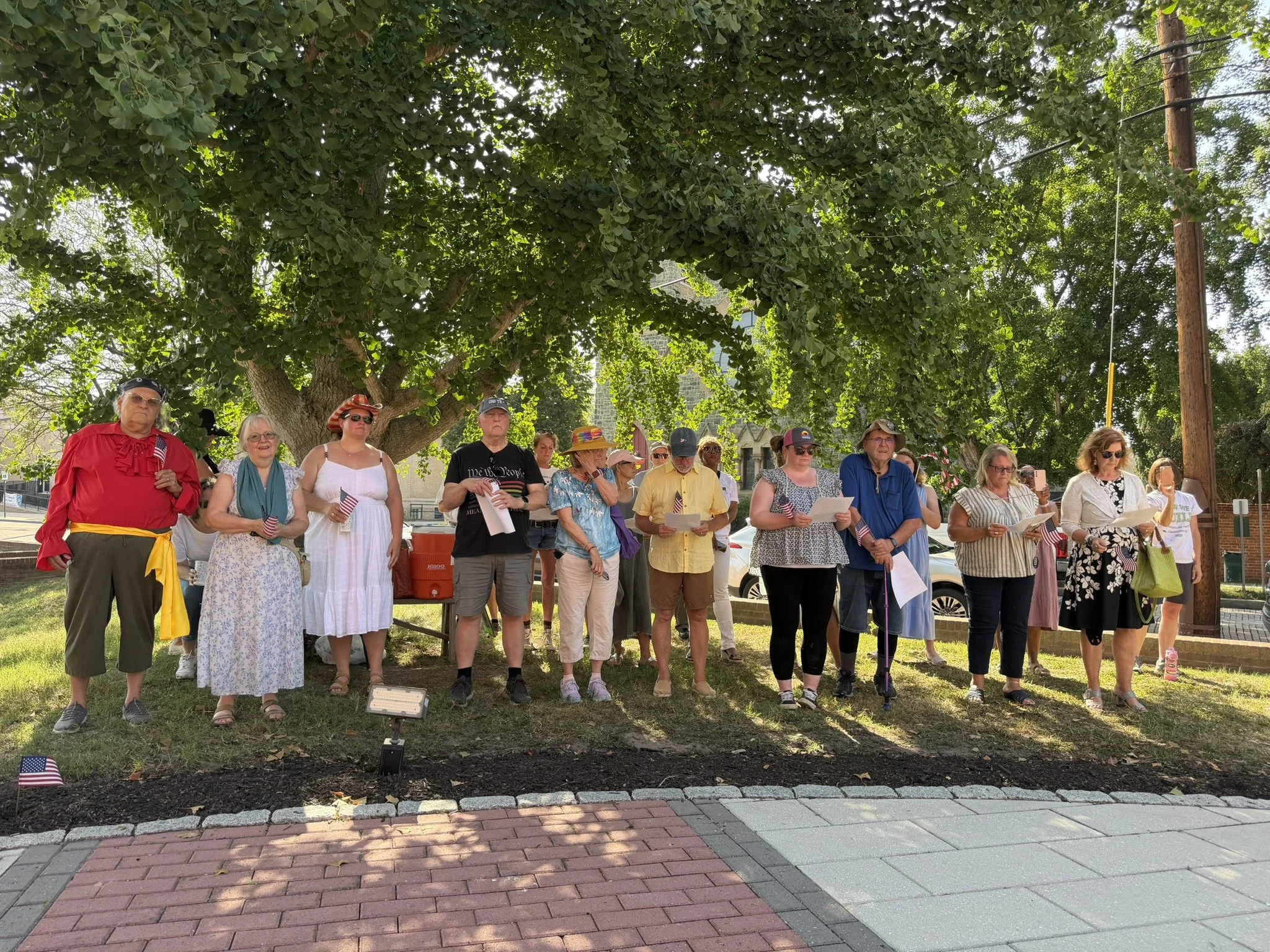
Two days before America turned 250, thirty of us stood on the courthouse steps in the heat and read our grievances out loud.
It was somewhere north of ninety degrees on Wednesday evening, with the kind of Eastern Shore humidity that settles over you like a wet wool coat and doesn’t leave. Not weather that flatters a crowd. Not weather that makes anyone feel especially revolutionary.
Thirty of us came anyway.
We gathered in front of the Dorchester County Courthouse in Cambridge — some in 1774 dress, ruffled shirts and tricorn hats, all of us sweating — to do something both very old and, lately, very necessary: read a list of grievances out loud, in public, with our names attached.
I’ll take thirty. In this county, in this heat, two days before the Fourth of July, thirty people who chose to spend a brutal evening this way is not a small thing. It’s the whole thing, actually. It has always been ordinary people who do the extraordinary things — not the powerful, and not the famous, but the ones who show up.
A hard year to throw a birthday party
This year, America turns 250.
You’ve seen the run-up — the bunting, the commemorative coins, the committees. And there is something in me, still, that wants to celebrate it. Two hundred and fifty years of an idea audacious enough to be worth arguing about ever since: that ordinary people can govern themselves, and that a government answers to them and not the other way around.
But we chose to mark the occasion on a particular patch of ground, and this ground does not let you off easy. On the same courthouse square where we stood reading, human beings were once bought and sold. In 1850, right here in Cambridge, Harriet Tubman’s niece Kessiah was put up on the auction block — and carried off to freedom before the sale could close. Tubman herself was born enslaved a few miles from where we were standing.
So how do you celebrate 250 years of a promise that was broken the day it was written, and is being broken again, in new ways, right now?
You don’t, exactly. You do something harder. You tell the truth about the country, out loud, in the town square — which, as it happens, is one of the most American things a person can do. In 1774, the colonists did exactly that. All over the thirteen colonies, ordinary citizens gathered at their courthouses and set down their grievances against a distant, abusive government. They called them Resolves. And Dorchester was in it from the start — the county sent its own men to the Annapolis convention that June.
We took up the quill again.
What we did
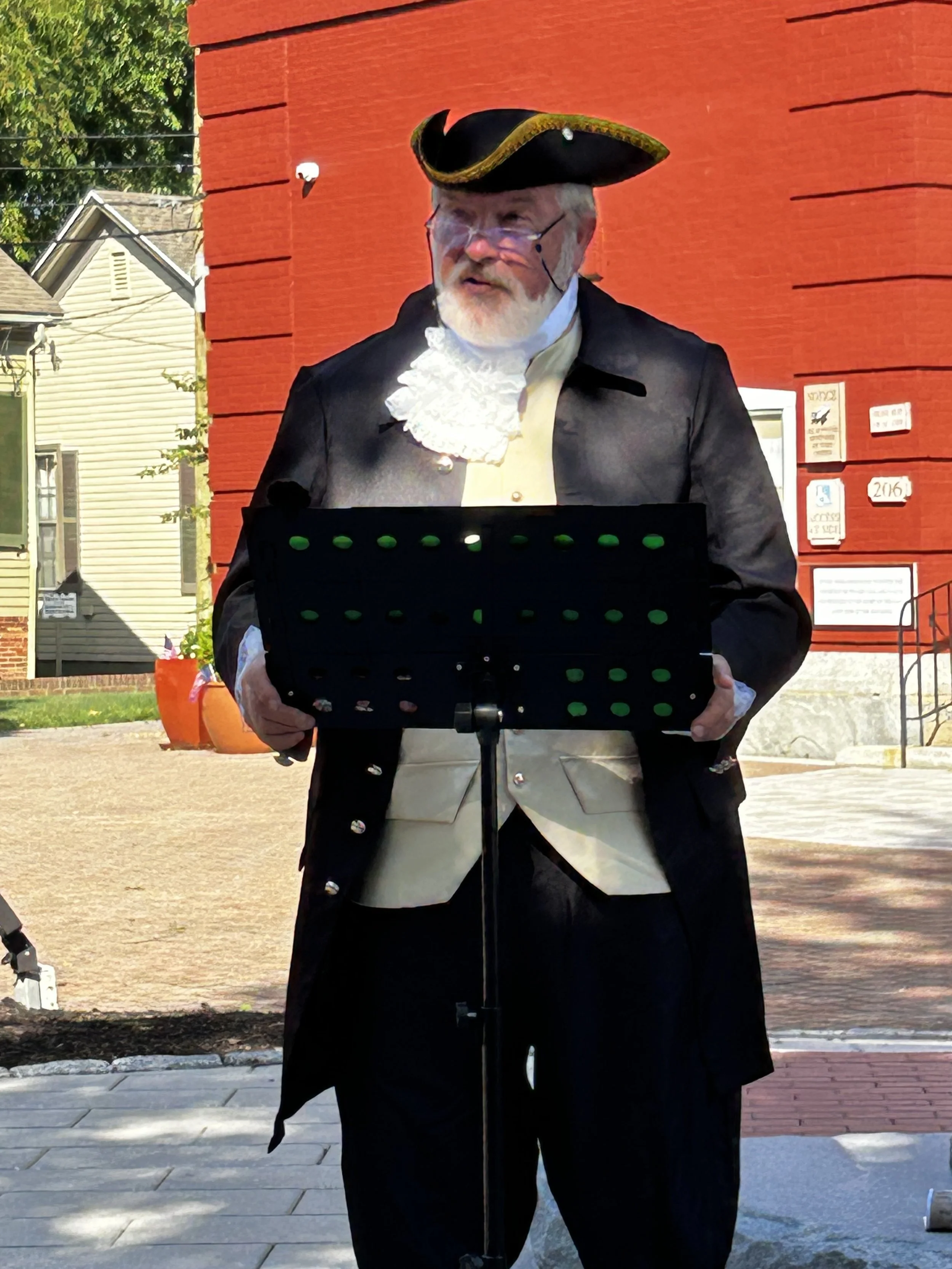
A town crier — a volunteer, in period costume — came up through the crowd ringing a brass bell and read the whole thing aloud, start to finish, prompting everyone to answer back with a good old-fashioned “Huzzah.” It is a strange and moving thing to hear your own county’s grievances proclaimed in the cadence of 1774. It makes the old words feel new, and the new words feel inevitable.
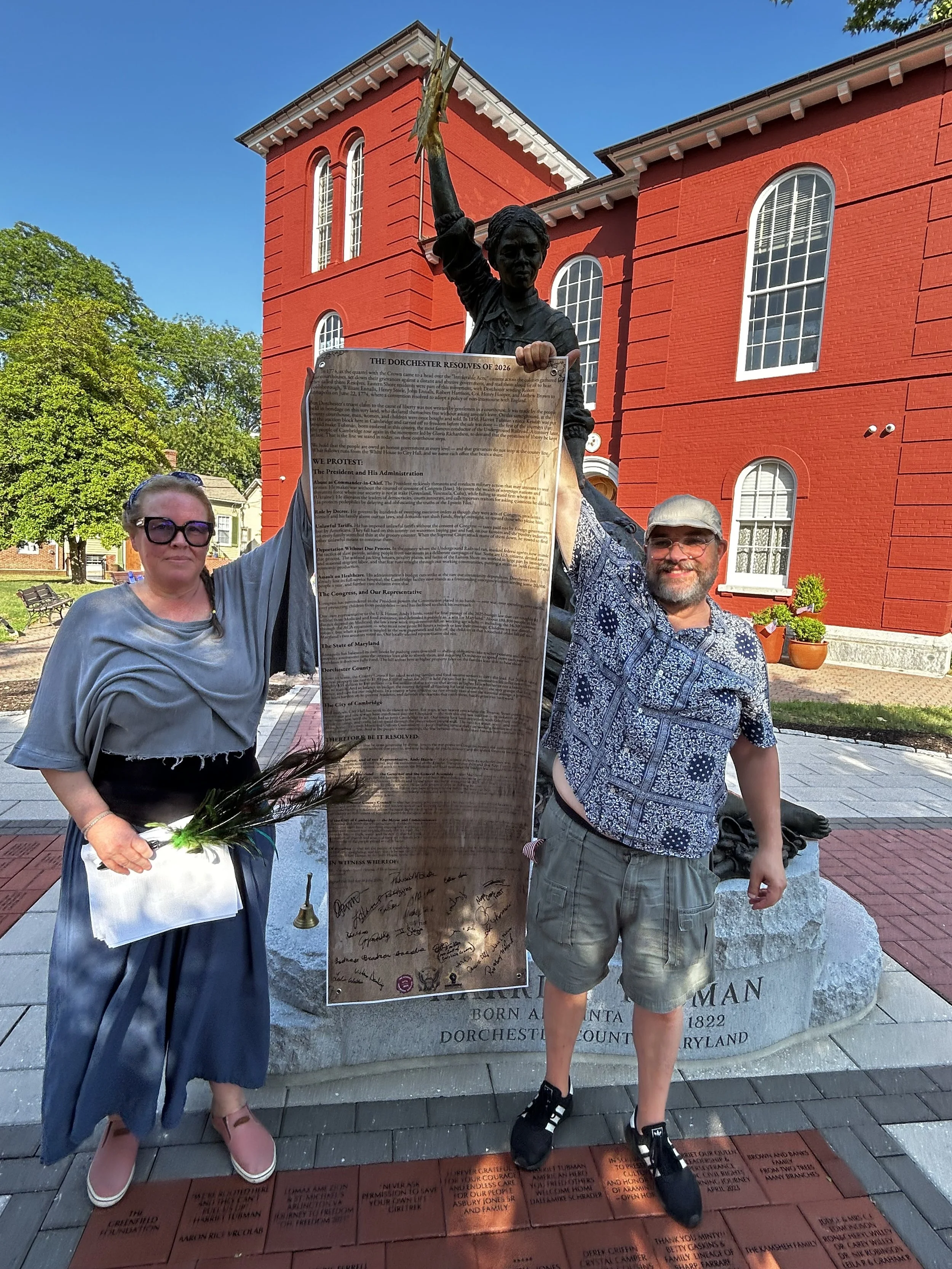
Then Linda Harris, director of the newly reopened Harriet Tubman Museum & Educational Center, stood up and connected the dots — this ground, this history, this fight, all one line.
And then we asked people to sign.
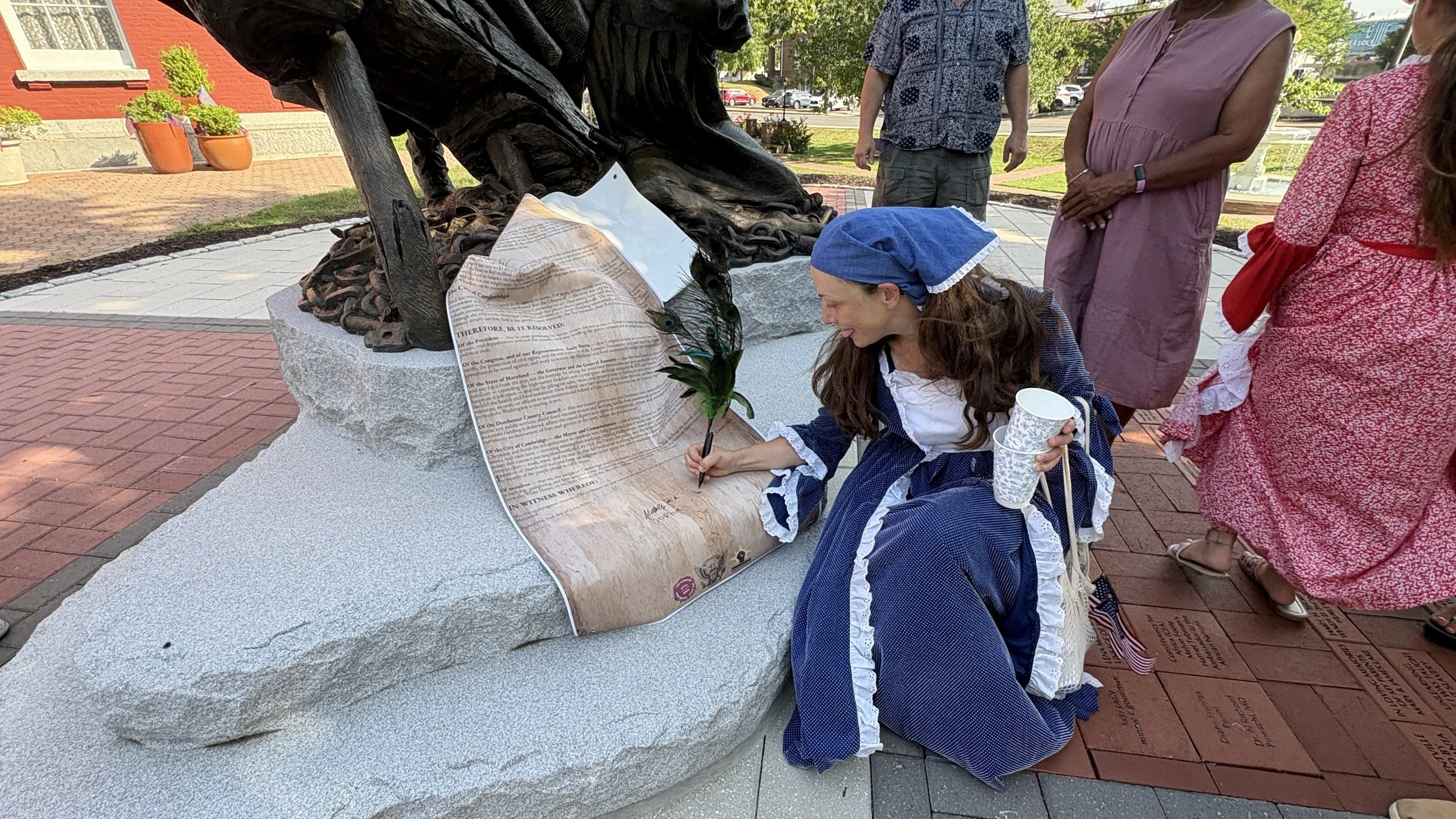
We’d printed the Resolves on a scroll — two feet wide and six feet long — and we laid it across the base of the Harriet Tubman statue, the one with a single word carved into the granite: HARRIET. And beneath it, BORN. And beneath that, DORCHESTER. One by one, people knelt on the memorial bricks and signed their names with a feather quill, the scroll draped over Tubman’s monument like an offering. Thirty signatures, resting on the base of a woman who never once waited for permission to be free.
Here is what we signed:
THE DORCHESTER RESOLVES OF 2026
In 1774, as the quarrel with the Crown came to a head over the “Intolerable Acts,” citizens across the colonies gathered at their courthouses, set down their grievances against a distant and abusive government, and read them aloud for all to hear. They called them Resolves. Eastern Shore residents were part of this movement, with Dorchester sending Robert Goldsborough, William Ennalls, Henry Steele, John Ennalls, Robert Harrison, Col. Henry Hooper, and Mathew Brown to Annapolis on June 22, 1774, where a convention resolved to adopt a policy of non-intercourse with England.
But Dorchester’s truest claim to the cause of liberty was not written by gentlemen in a courthouse. It was made by the people held in bondage on this very land, who declared themselves free without asking anyone’s leave. On this same ground, at the county courthouse, men, women, and children were once bought and sold.
In 1850, Harriet Tubman’s niece Kessiah was put on the auction block here in Cambridge and carried off to freedom before the sale was done — the first of the journeys that would make Tubman, born enslaved in this county, the most famous conductor of the Underground Railroad. A century later, the people of Cambridge rose again in the movement led by Gloria Richardson, to demand that the promises of liberty be kept at last. That is the line we stand in today, on these courthouse steps.
We hold that the people are owed an honest government at every level — and that grievances do not stop at the county line. What follows runs from the White House to City Hall, and we name each office that bears a share.
WE PROTEST:
The President and His Administration
Abuse as Commander-in-Chief. The President recklessly threatens and conducts military action that may amount to war crimes. He makes war without the counsel or consent of Congress (Iran). He covets the wealth of sovereign nations and threatens force where our security is not at stake (Greenland, Venezuela, Cuba), while failing to stand firm where it is (Ukraine). He alienates the leaders of democracies, courts autocrats, and calls reporters traitors for asking questions he dislikes. He protects pedophiles by delaying and obfuscating the truths of the Epstein Files.
Rule by Decree. He governs by hundreds of sweeping executive orders as though they were acts of Congress, proclaims himself and his family above our tax laws, and demands vast slush funds, free of oversight, to reward those who please him.
Unlawful Tariffs. He has imposed unlawful tariffs without the consent of Congress — taxes paid not by foreign governments but by Americans. They fall hard on this county: on watermen buying gear and fuel, on our farmers and the poultry industry, on every family stretched thin at the grocery counter. When the Supreme Court struck many of them down, he vowed to find other unlawful means to continue them.
Deportation Without Due Process. In the county where the Underground Railroad ran, masked federal agents now mimic the tactics of slave patrols, seizing people from our streets in a deliberate campaign of fear. Some are U.S. citizens, denied any due process. The seafood packing houses, poultry plants, and farms of the Eastern Shore are worked in large part by immigrant and seasonal migrant labor, and that fear runs straight through our working communities, putting a strain on both families and economic production.
Assault on Healthcare. His administration’s budget cuts strike at the care our community depends on. Dorchester has already lost its full-service hospital; the Cambridge facility now stands as a freestanding emergency center serving some 20,000 patients a year, and further cuts threaten even that.
The Congress, and Our Representative
Congress has surrendered to the President powers the Constitution placed in its hands — over war, over spending, over tariffs — and has declined to check his overreach.
Our own representative to the U.S. House, Andy Harris, voted for final passage of the 2025 budget law that cut roughly $1 trillion from Medicaid and food assistance, and defended it publicly as “a win for Maryland.” About 188,800 people in his district depend on Medicaid; the law’s new work requirements fall on working-age adults — including the 54,300 covered through the ACA expansion — who must now prove 80 work hours a month or lose their coverage. Children are not directly subject to that requirement, but when a parent is tangled in the new paperwork and falls off, the children in that household often fall off too. Maryland’s two senators voted no. Our locally elected representative did not.
The State of Maryland
Annapolis has balanced its own books by pushing costs downhill — shifting obligations like teacher pensions and the cost of property assessments onto the counties least able to absorb them, and requiring Dorchester to spend more each year on mandates it does not fully fund. The bill arrives here as higher property taxes on the families least able to bear them.
Dorchester County
Closer to home, the County Council has asked working families and fixed-income seniors to carry the load. For 2026 it raised the real property tax rate to $1.03 per $100 of value; for 2027 it held the rate but let rising assessments lift collections from roughly $35 million to $40 million — a five-million-dollar increase that arrives as higher bills whether or not a family’s income rose to match. And to balance its budget, the county deferred all funding for local nonprofits — the very groups that feed, shelter, and care for our neighbors. In a county whose effective tax rate already runs above the national average, a government that leans hardest on its poorest residents, and defunds the charities that catch them, has its priorities backward.
The City of Cambridge
And our own City Hall has work to do closest to home. For years, when storms overwhelm the Trenton Street pump station, stormwater and raw sewage have overflowed into the Choptank — the river this city was built on — in violation of federal clean-water law, until the State had to press Cambridge to act. Our streets have been neglected, with faded lane markings, unsafe crossings, and traffic left to speed through the places where people walk. The rates for water, sewer, and trash — billed through the city’s own Municipal Utilities Commission — keep climbing substantially on working families and seniors who cannot simply use less. And at the people’s own meetings, the line between church and state has not been carefully kept.
THEREFORE, BE IT RESOLVED:
Of the President — that he cease governing by decree, return the war power to Congress, respect the authority of our judicial system, end deportations without due process, and stop bending the public treasury and the armed forces to his private and political ends.
Of the Congress, and of our Representative, Andy Harris — that Congress reclaim its authority over war, spending, tariffs, the protection of civil rights, and the enforcement of the Epstein Transparency Act; and that Rep. Harris answer to the constituents he voted against, and work to restore the Medicaid and food assistance the budget law stripped from them.
Of the State of Maryland — the Governor and the General Assembly — that Maryland stand as a firewall for its people and pay for it from the top, not the bottom: by asking the wealthiest Marylanders and most profitable corporations to pay their fair share — extending the high-earner brackets and capital-gains surcharge it enacted in 2025, and finally closing the corporate loophole it left open — and not by piling on sales, excise, and property taxes or shifting its costs onto counties like ours; that it backfill the health and food assistance these federal cuts have stripped, to the fullest the state can bear; refuse to lend Maryland’s resources, records, or officers to unconstitutional federal action; and write into state law the human rights and environmental protections Washington is tearing down.
Of the Dorchester County Council — that our county government put Dorchester first: defend local healthcare, food access, and public services; shield fixed-income seniors and working families from assessment-driven tax increases; restore the nonprofit funding it deferred; affirm the equal dignity and rights of every resident, citizen and immigrant alike; refuse to make our county an instrument of fear; and govern in the open, where the people can see.
Of the City of Cambridge — the Mayor and Commissioners — that it bring an end to the sewage overflows fouling the Choptank and finish the infrastructure its residents were long promised; that it make our streets safer for everyone who lives, works, and visits here — restoring missing lane markings, slowing traffic where speed puts people at risk, and creating safe routes that connect our neighborhoods to City Hall, the library, the parks, and the waterfront; that it hold the line on the everyday fees — trash, water, and the rest — that fall hardest on working families and fixed-income seniors; that it respect the separation of church and state and force no religious belief upon the city’s residents; and that it invest in streets, services, and a city worthy of the people proud to call it home.
Of ourselves — that we, the people of Cambridge and Dorchester, do not look away: that we keep the record, refuse to give in to bullying, gaslighting, and hate speech by our elected officials, attend the meetings, cast the votes, and hold every office — from the White House, to the State House, to the Sheriff’s Office, to City Hall — to account.
IN WITNESS WHEREOF:
We, the undersigned citizens of Dorchester, set our names to this record at the Dorchester County Courthouse, Cambridge, Maryland.
Signed this 2nd day of July, 2026.
Then we walked
When the last name was signed, we walked — a few blocks over to 424 Race Street, where Linda Harris gave us a private tour of the newly renovated Harriet Tubman Museum & Educational Center.
If you have not been inside since it reopened, go. This is not a museum of glass cases and velvet ropes. The entire building is the exhibit — the walls, floor to ceiling, are painted into Tubman’s world, so that you don’t look at the artwork so much as stand inside it. The whole place is the artwork itself. It is, plainly, a must-see, and Linda is the kind of guide who makes you feel like you’ve been let in on something.
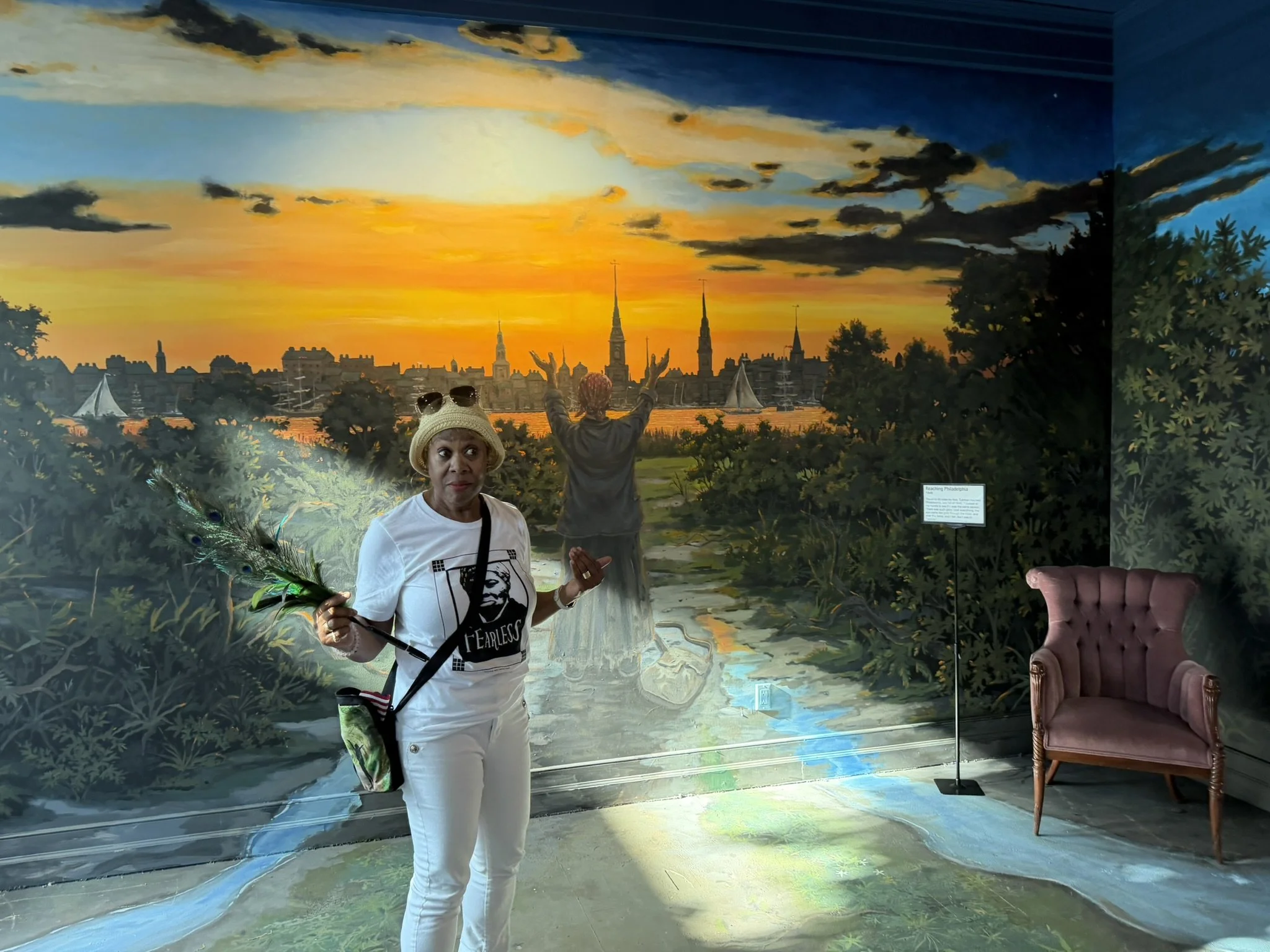
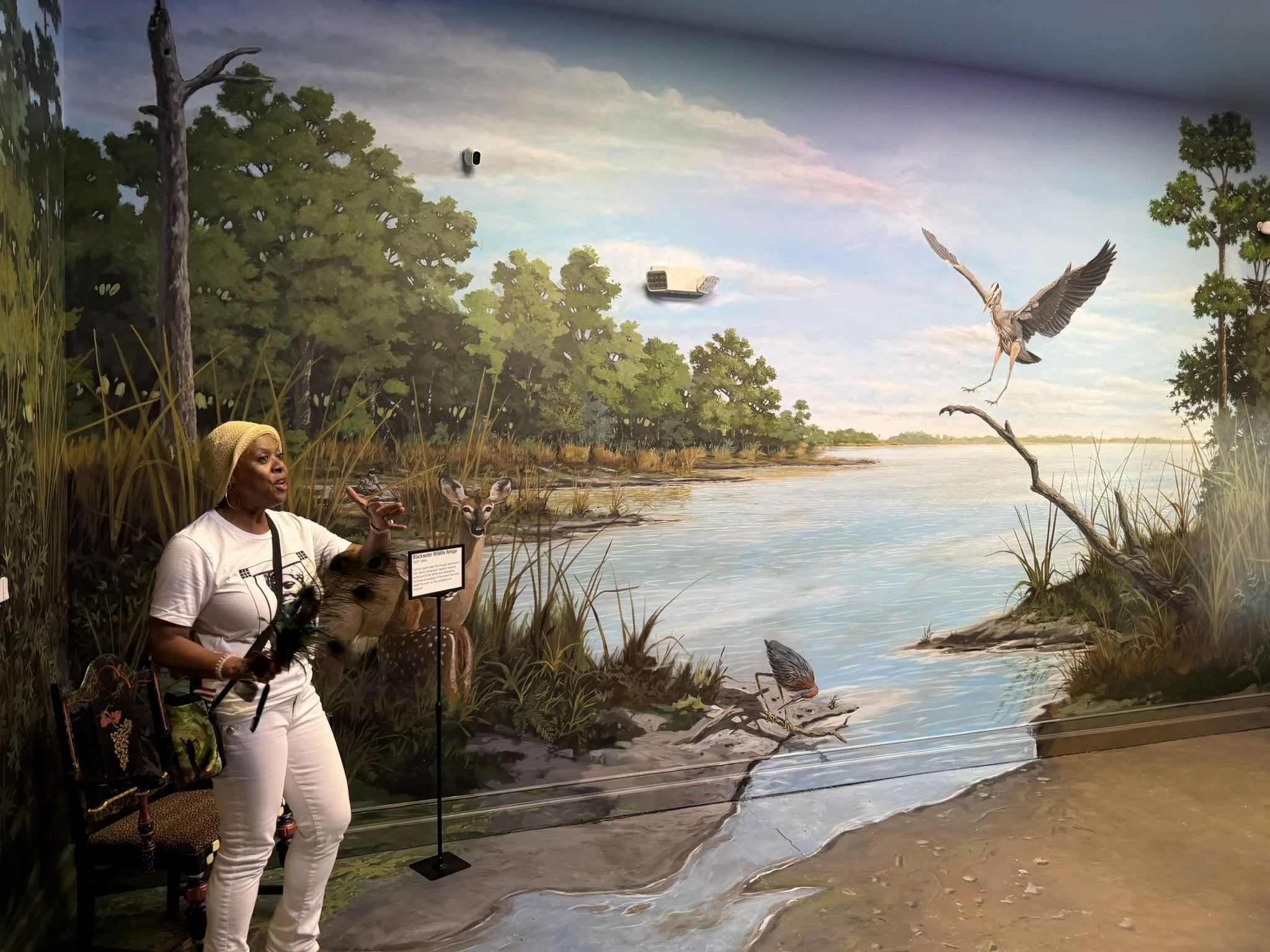
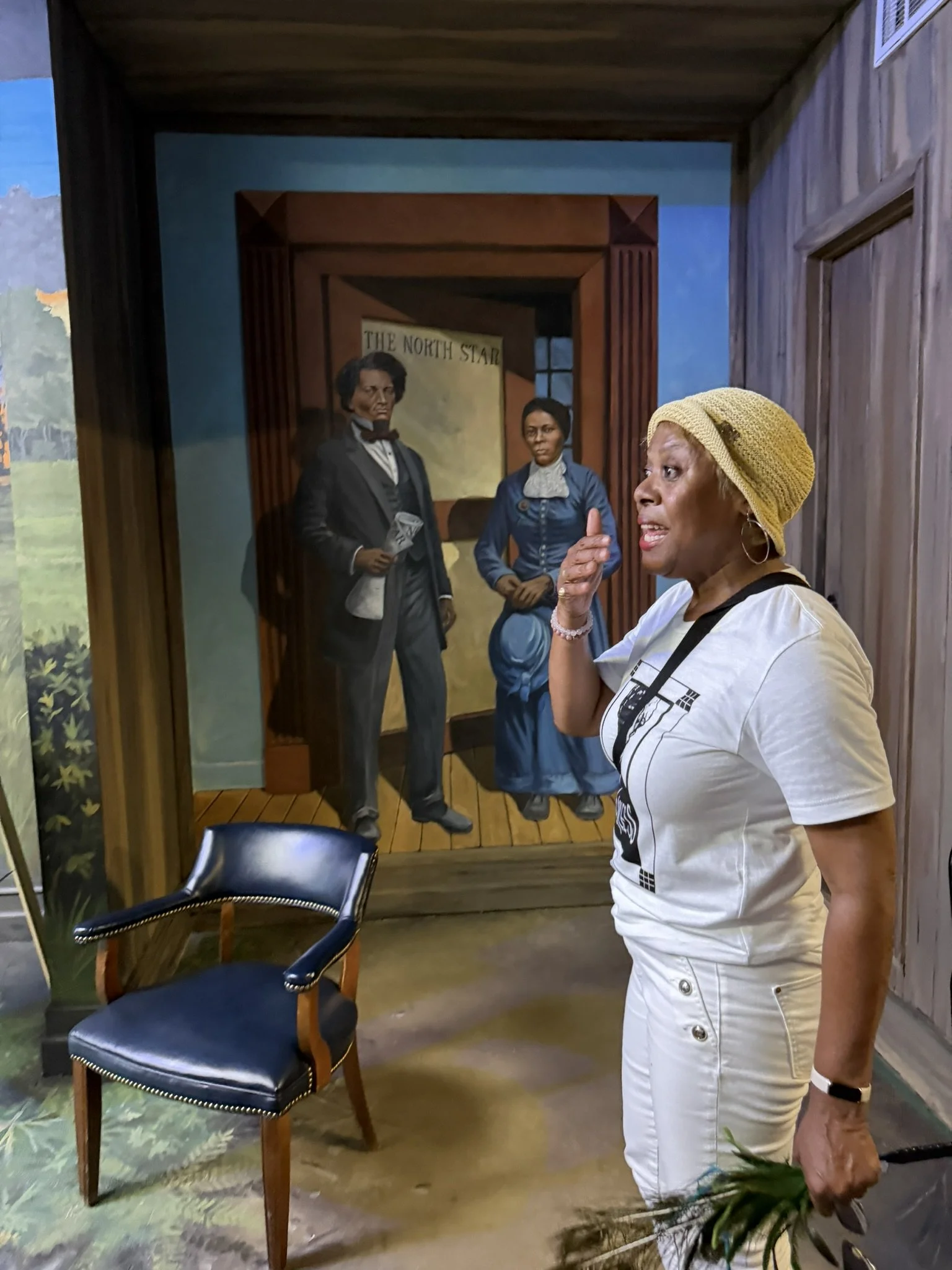
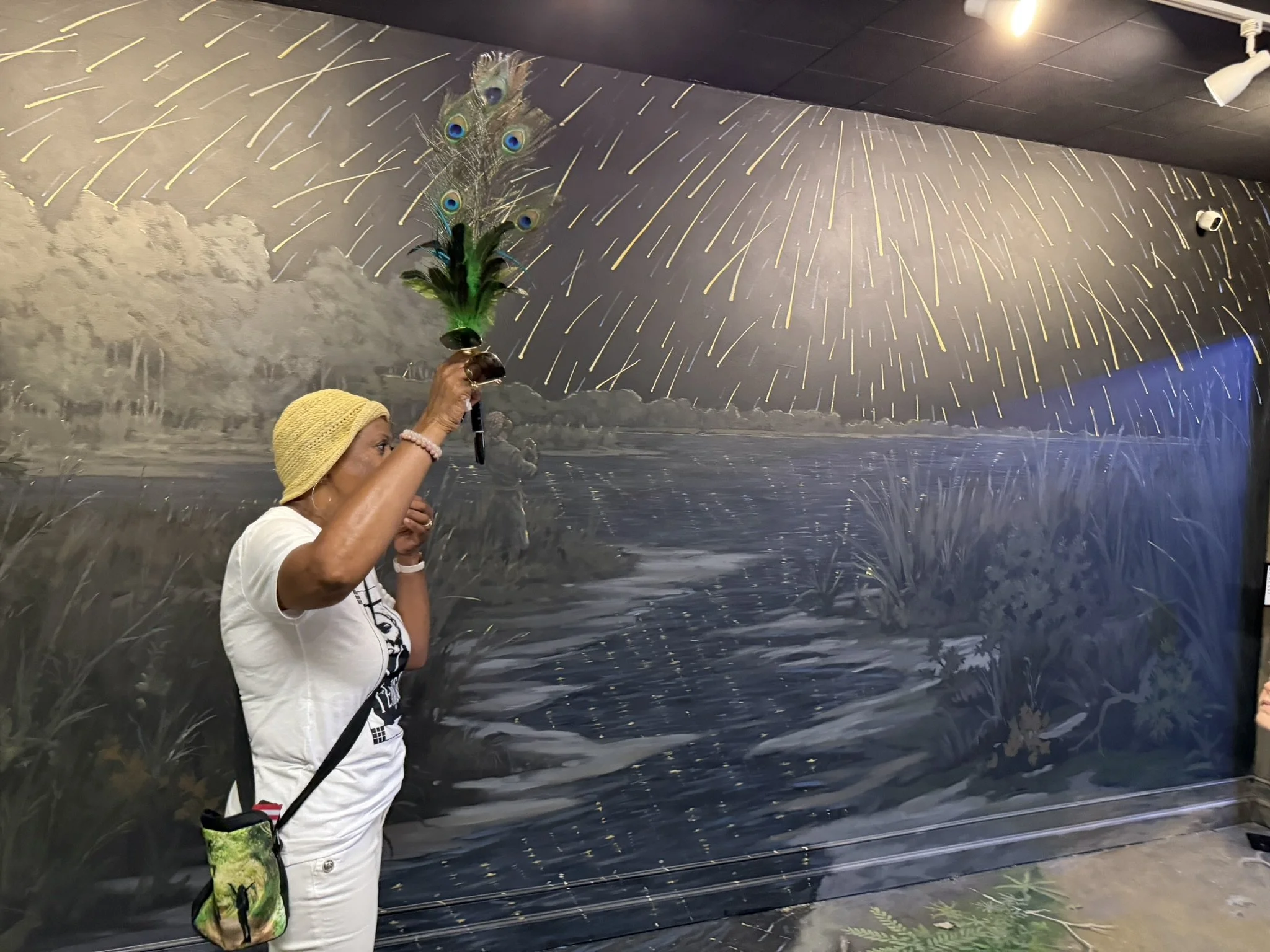
This is where the day earned itself.
The museum has wrapped its walls in immersive murals, and Linda moves through them like she’s walking you through her own family’s rooms — because, in every way that matters, she is. There’s Tubman on the Combahee River, leading the raid that freed some 750 people in a single night, the only woman to plan and lead an armed military operation in the Civil War. There she is again at the edge of the marsh, arms raised, the Philadelphia skyline glowing across the water on the morning she crossed into freedom and, as she said, felt like she was in heaven. There’s Frederick Douglass and the North Star. There’s the Blackwater marsh where she learned the land by heart. There’s Joseph Stewart’s Canal, seven miles dug by enslaved hands over twenty years — the ground where a girl learned the woods well enough to lead others out of them.
We had spent the evening naming what a distant government is doing to us. In the museum, we stood inside the story of people who faced infinitely worse and refused to accept it as the last word. It closed the circle. The courthouse where people were sold is three blocks from the museum that tells how they freed themselves. That is Dorchester County. That is America.
The whole country in one walk
Here’s the thing about the 250th that the fireworks can’t quite hold. America is both of those places at once — the auction block and the Underground Railroad, on the same ground, in the same town. It always has been. We are the country that wrote “all men are created equal” while holding people in chains, and we are also the country that produced the people who took that sentence more seriously than the men who wrote it did.
You don’t have to choose one story. You’re not supposed to. You hold the cruelty and the courage in the same hand, and you decide, every generation, which one you’re going to add to.
Harriet Tubman didn’t wait for the country to keep its promise. She went back into the dark, again and again, and kept it herself — one person at a time, without permission, at gunpoint odds. Gloria Richardson stood on these same streets a century later and did the same. And none of them began as monuments. Tubman was a girl who knew the marsh by heart. Richardson was a mother from Cambridge. The men who carried the first Resolves to Annapolis were farmers and watermen and shopkeepers. Ordinary people, every one — which is the only kind who have ever changed anything. That is the line we were standing in on Wednesday, thirty of us, sweating through our shirts on the courthouse lawn.
We are not Harriet Tubman. Let’s be honest about the scale of it. We signed a scroll; she risked her life dozens of times over. But the faith is the same faith — that the promise is worth insisting on, out loud, in public, whether or not the powerful are inclined to keep it. That a country becomes what its people are willing to stand in the heat and demand.
Two hundred and fifty years in, the work is not finished. It was never going to be finished. That’s not the bad news — that’s the assignment. The founders handed us an argument, not a monument, and the argument is still ours to win.
We left something behind, too. We’ve donated the six-foot scroll — the Resolves, and the names already signed on it — to the Harriet Tubman Museum & Educational Center, to be displayed there. It felt right. The document belongs on that ground, in that building, among those murals — the record of one generation’s grievances, kept in the house of the woman who answered her own generation’s with her life.
And it isn’t finished either. There’s still room on it. So this is the invitation: go to the museum, stand inside the artwork, and add your name to the Resolves where they now live. Make yourself part of the record.
The scroll bears thirty names tonight. Come summer, we’ll add more.
Hold steady. Go see the artwork. And sign your name — there’s room.
The Dorchester Resolves were read on the steps of the Dorchester County Courthouse on July 2, 2026, and the signed scroll now resides at the Harriet Tubman Museum & Educational Center, 424 Race Street, Cambridge. Cambridge Indivisible is a volunteer-led, grassroots organization on Maryland’s Eastern Shore. Come see the museum, add your name to the Resolves, and find out when we gather next — we’d love to have you.